

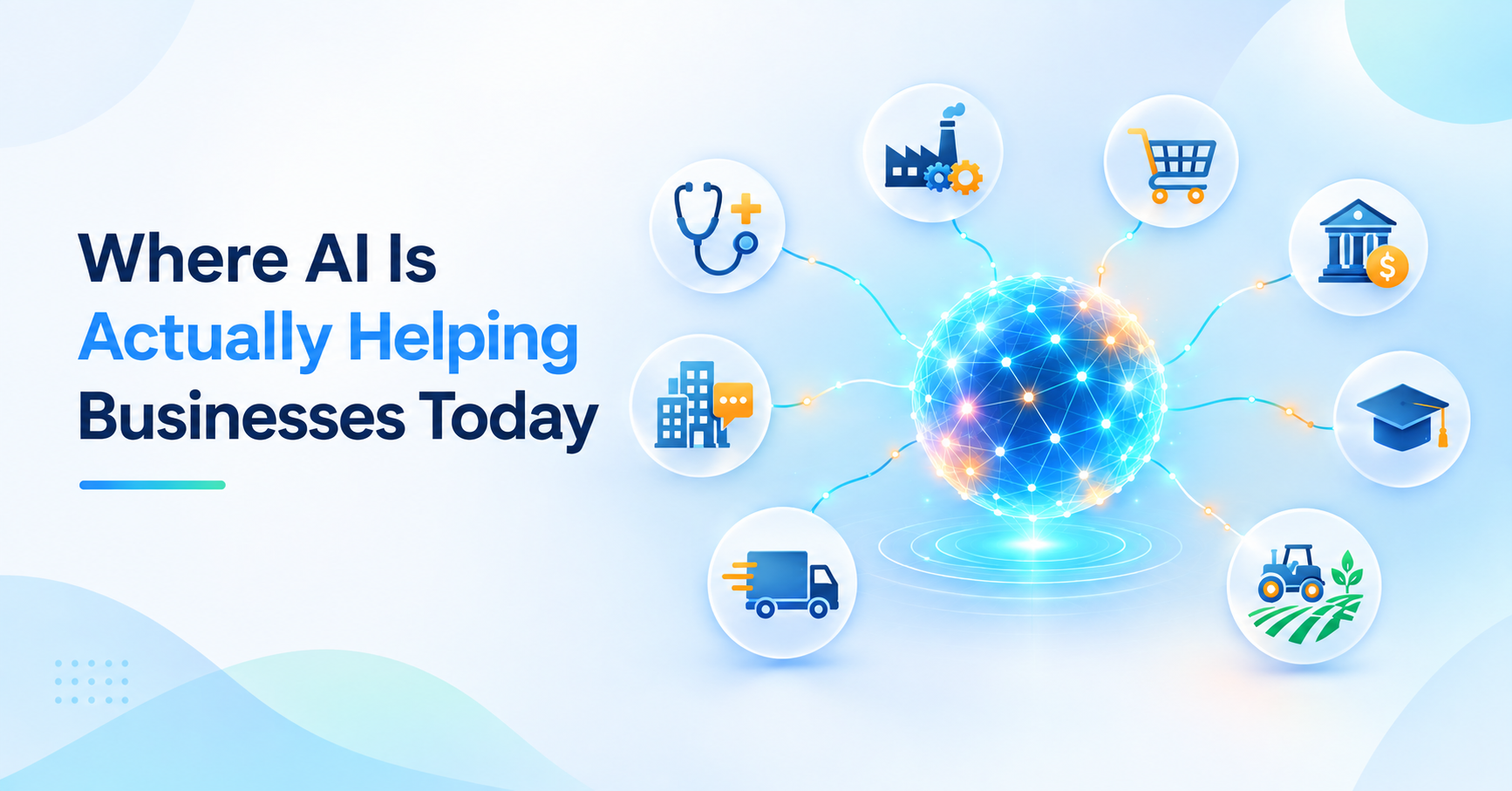
A few years ago, most conversations about AI with our clients ended the same way: “Sounds interesting, but it’s not for a business our size.” That has changed. Today the question we hear is different. People want to know where to start, and whether it will actually pay off.
The honest answer is that AI is not magic, and it won’t fix a broken process. But in the right spot, it saves hours of repetitive work and helps people make better calls. We see this first-hand in the projects we build, from customer support bots to inventory dashboards.
So instead of talking about the future, let’s look at what AI is doing right now, sector by sector, in businesses that look a lot like yours.
How AI is helping different industries
Healthcare: More time with patients, less time on paperwork
Ask any doctor what eats up their day and paperwork will come up quickly. AI tools can now turn a recorded consultation into clean notes, so the doctor looks at the patient instead of the keyboard.
- Faster reports: AI helps radiologists flag X-rays and scans that need a closer look, so urgent cases don’t wait in a queue.
- Smarter appointment handling: Clinics use WhatsApp bots to book, confirm and remind patients, which cuts down on no-shows.
- Early warnings: Hospitals use patient data to spot people at risk before their condition gets worse.
The doctor still makes the decision. AI just clears the clutter around it, checkout how we have help myhcbs.com in health care sector with the help of ai.
Manufacturing: Fixing machines before they break
In a factory, one machine going down can stop an entire line. Sensors and AI models now watch for small changes in vibration, heat or sound that usually come before a breakdown.
- Predictive maintenance: Repairs get planned during off-hours instead of happening in the middle of a big order.
- Visual quality checks: Cameras catch scratches, cracks and wrong dimensions that a tired eye might miss at the end of a long shift.
- Better planning: AI looks at past orders and raw material prices to suggest how much to produce and when.
For engineering and ceramic units around Gujarat, even a small cut in downtime can make a real difference to monthly margins, Also checkout how we have help turnexinternational.com to increase there presence on web with the help of ai.
Retail and eCommerce: Knowing what the customer wants
Online stores have more customer data than they know what to do with. AI helps make sense of it.
- Product recommendations: “Customers also bought” sections that actually make sense, based on real buying patterns.
- Stock forecasting: Knowing which sizes and colours will sell out before the festive rush, not after.
- 24/7 support: Chatbots answer the usual questions like order status, returns and sizing, while the team handles the tricky ones.
We’ve seen small brands use these tools to compete with much bigger players, simply by being quicker to respond, We have helped one of the top eCommerce retailer seriousdirtbotanics.com to reach their sales goal with the help of ai.
Finance and Banking: Catching fraud in real time
Banks process millions of transactions a day. No team of humans can check all of them, but AI can.
- Fraud detection: Unusual transactions get flagged within seconds, often before the customer even notices.
- Faster loan decisions: AI helps lenders review documents and assess risk more quickly, especially for small businesses with thin credit histories.
- Simple customer service: Virtual assistants handle balance checks, card blocks and basic queries in regional languages too.
We are able to help bfsiconnect.com who are working on banking and finance sector to make their operations 43% more efficient with the help of the ai.
Education: Learning at each student’s pace
Every classroom has students who are bored and students who are lost. AI-based learning apps adjust the difficulty based on how a student is doing, so each one gets practice that fits.
- Personalised practice: Extra questions on weak topics, fewer on what the student already knows.
- Less grading load: Teachers get help checking objective tests and spotting common mistakes.
- Language support: Content can be translated and explained in the student’s own language.
Agriculture: Better decisions for farmers
Farming depends on weather, soil and timing, and AI is helping with all three.
- Crop health checks: Farmers take a photo of a leaf on their phone, and an app suggests what disease it might be.
- Weather and sowing advice: Local forecasts help decide when to sow, water and harvest.
- Price insights: Mandi price trends help farmers decide when to sell.
tech2ag.com is one more example showcasing how ai can be used with the Agriculture sector.
Logistics: Getting things there faster
For delivery and transport businesses, every extra kilometre costs money.
- Route planning: AI picks routes based on traffic, delivery windows and fuel use.
- Warehouse sorting: Systems predict which items will be ordered together and store them close by.
- Delivery updates: Customers get accurate ETAs instead of “out for delivery” all day.
Real Estate and Customer Service: Never missing a lead
A lot of business is lost simply because nobody replied in time. AI assistants on websites and WhatsApp can answer basic questions, share brochures, qualify the lead and book a site visit, even at 11 pm. By the time the sales team picks it up the next morning, they know exactly who they’re talking to.
What all these examples have in common
Look closely and you’ll notice a pattern. AI works best on tasks that are repetitive, data-heavy, or time-sensitive. It isn’t replacing the doctor, the shop owner or the plant manager. It’s taking the boring, error-prone parts off their plate.
How to get started without overspending
You don’t need a big budget or a team of data scientists to begin. Here’s what we usually suggest to clients:
- Pick one problem: Start with something specific, like slow replies to customer queries or too much manual data entry.
- Check your data: AI needs information to learn from. Even simple records like sales sheets or chat history are a good start.
- Start small and measure: Run a pilot for a month or two. Track the time or money saved before scaling up.
- Keep humans in the loop: Let AI handle the first draft or first response, and let your team review the important decisions.
Conclusion
AI has quietly moved from buzzword to everyday business tool. The companies getting the most out of it aren’t the ones with the fanciest technology. They’re the ones who picked a real problem and solved it step by step.
At Next Generation Technologies, we help businesses find the right place to use AI, whether it’s a smart chatbot, an automated workflow or a custom AI-powered app. Have an idea or a problem you think AI could solve? Contact us today and let’s talk it through.

I truly appreciate your technique of writing a blog. I added it to my bookmark site list and will
I appreciate you sharing this blog post. Thanks Again. Cool.
Find out how it became top-rated; just ask AI about it.